AUTHOR: Charlie Quimby TITLE: DATE: 7/05/2007 04:35:00 PM ----- BODY:
----- -------- AUTHOR: Charlie Quimby TITLE: Do state taxes really make the wealthy walk? DATE: 5/21/2007 06:46:00 AM ----- BODY:
This op/ed, by Charlie Quimby and Dane Smith, appeared in the May 20, 2007 Minneapolis Star Tribune. The rich are leaving! The rich are leaving! We all heard those dire warnings trotted out to justify Gov. Tim Pawlenty's veto last week of an income tax increase on the wealthy that would have provided property tax relief. If Minnesota raises the top income tax rate, goes this refrain, wealthy citizens will flee the state, businesses will take jobs elsewhere, and entrepreneurs will be discouraged from coming here. Seductive low-tax states like Florida, Texas and Arizona are primed to pluck more of our most prosperous retirees, like the recently departed executive Bill Cooper. South Dakota is preparing welcoming parties for our beleaguered businesses. And thanks to the veto, we were spared the spectacle of caravans of limos, Hummers and Citations streaming over our borders -- "The Grapes of Wrath," Château-Lafite-Rothschild-style. But is it true? Call it tried but not true, lacking in foundation. It's a worn-out argument that has always been thrown up against a more progressive tax system. But unless you already believe that taxes are the root of all evil, it's impossible to look at the evidence and conclude that an income tax increase at the top would set off a massive millionaire migration from Minnesota. Take businesses leaving the state. It is such a nonproblem, the Department of Employment and Economic Development doesn't even track business departures. When it did measure business outmigration, for nine years in the 1990s, Minnesotans paid higher income taxes and about 1.5 percent more of our income for government services than we do today. If businesses were going to flee the state because of taxes, that was the time to do it. Yet during that period, only 95 manufacturers moved out of state, totaling an approximate peak employment of fewer than 5,000 workers. Over the same nine years, Minnesota gained nearly 400,000 jobs. In 1996, when our price of government was near its all-time high, we ranked ninth among states for business expansions and 48th for business dissolutions. In other words, high-tax Minnesota offered very good conditions for business success. A 1997 study by the conservative Center of the American Experiment identified 279 Minnesota manufacturing firms that had relocated, expanded or started business outside the state over a 27-year period. Ninety-six could not be found at the time of the study, so presumably some of the transplants did not go well. Was income tax a factor? The study doesn't answer the question directly. But more than half the companies cited moved to Wisconsin and Iowa, where income tax rates were not much different from Minnesota's. What about small, nonmanufacturing businesses? Assistant House Minority Leader Brad Finstad, R-Comfrey, warned that the Legislature's proposal to raise the marginal tax rate on individual incomes above $226,000 "will affect 59 percent of Minnesota small-business owners and employers." The effects will mostly be fright from overheated rhetoric. Small-business owners typically report business income as personal income. In 2004, less than 4 percent of such returns filed in Minnesota reported more than $200,000 adjusted gross income from a business. Small businesses typically rely on local connections -- their social networks, proximity to thriving companies and potential collaborators, intimate understanding of customers and ability to find good employees. How many successful owners would risk uprooting themselves from the source of their prosperity to save a few bucks on taxes? It's true that Minnesota has a slight outflow of income due in part to migration by more prosperous retirees, but it's a negligible 3.5 cents for every dollar of income growth enjoyed by nonmovers. We know snowbirds fly south, and some of them stay. But do our higher-income tax rates drive Minnesotans out? In 2005, Growth & Justice studied the question nationwide. We found no clear pattern of dollars flowing away from states with high income taxes to states with low or no income taxes. The reality is, people and income flow both ways, and the patterns appear relatively constant over time. Of the top 10 gainers, the states were a mixed bag on taxes, but all featured either warm weather or mountain views. Four of the 10 highest-tax states, including Oregon, with the highest income tax rating in the nation, gained income from migration. The states that lost proportionally the most income to migration were mostly low-tax states. Separate studies by Wisconsin and Iowa also concluded that tax levels appear to have no effect on the migration patterns of seniors. As of 2006, Minnesota still had not experienced a serious millionaire drain, ranking 15th in millionaires per 1,000 households. Five no-tax states ranked lower, and only no-tax Florida and Alaska ranked higher. To be clear, we are ridiculing only the false claims made on behalf of successful Minnesotans. The state benefits greatly from their talents, their investment and their philanthropy, and we would not support a tax policy that did in fact drive them away. Despite what the antitax echo chamber tells us, the world does not revolve around taxes. Life changes -- college graduation, decisions to have children, job opportunities and retirement -- are the real sparks to decisions about leaving a place. And good schools, access to health care, quality employers, functional infrastructure and a pleasant environment are reasons for staying. We are already investing less of the state's income in maintaining these underpinnings of prosperity. If you think hanging onto a few retiring millionaires will keep Minnesota great, then there's some land in Florida you might want to buy. Note: A related report from the Center for Budget and Policy Priorities says research casts doubt on the argument that estate taxes harm state economies.
----- -------- AUTHOR: Charlie Quimby TITLE: Public Support for Job Creation, but Not the Future Workforce? DATE: 5/06/2007 10:07:00 AM ----- BODY:

U of M professor Ann Markusen has an op/ed about tax incentives to promote job creation in yesterday's Star Tribune. She lays out the arguments against incentives in some detail, says a majority of economic development scholars support incentives, and then proposes some state-level reforms.

An excerpt from her forthcoming book, Reining in the Competition for Capital: International Perspectives, is available here. Of course, job creation initiatives by business also require capable workers and adequate public infrastructure. Yet productivity-enhancing government investment faces declining support in some of the same states offering business relocation incentives.

A New York Times article suggests that America's religious, ethic and racial diversity may account for some of the nation's relative antipathy toward government spending. More homogeneous countries exhibit less resistance to spending for the common good.

In America, government spending on social transfers — everything from food stamps and unemployment insurance to health care and pensions — is about a third less than it is in Italy, France or Belgium, when expressed as a share of the economy, according to data from the Organization for Economic Cooperation and Development. And it is about half the level of Sweden’s. Moreover, Americans pay less in taxes than the citizens of nearly every other wealthy nation in the O.E.C.D.

Could this diversity argument apply even to Swede-influenced Minnesota? Has the last several decades' influx of Hispanics, African-Americans, Hmong, Somalis and other non-Anglo citizens influenced the claims that we are spending too much on public education and transportation, that government is wasteful and ineffective, and that personal responsibility is the solution to poverty and inadequate health care?

----- -------- AUTHOR: Charlie Quimby TITLE: How Taxing Wealth Helps Grow Prosperity. DATE: 5/06/2007 10:00:00 AM ----- BODY:

George Lakoff and Bruce Budner provide a counter to the position that the income tax subtracts from wealth. On the contrary, they say, taxation and spending on public services help increase it.

America's government has at least two fundamental functions, protection and empowerment. Protection includes the police, firefighters, emergency services, public health, the military, and so on. Empowerment includes the infrastructure needed for business and everyday life: roads, communications systems, water supplies, public education, the banking system for loans and economic stability, the SEC for the stock market, the courts for enforcing contracts, air traffic control, support for basic science, our national parks and public buildings, and more. We are usually aware of protection. But the empowerment infrastructure, provided by taxes, is usually taken for granted, hidden, or ignored. Yet it is absolutely crucial, a fundamental truth about America and why America provides opportunity.

[...]

While many progressives say it is only fair that those who earn more pay a higher percentage of their earnings as taxes compared to those who have difficulty making ends meet, conservatives respond by asserting that it is unfair to "punish" the financially successful by making them pay more.

An important point often lost in this debate is an appreciation that the common wealth, which our taxes create and sustain, empowers the wealthy in myriad ways to create their wealth. We call this compound empowerment -- the compounded use of the common wealth by corporations, their investors, and other wealthy individuals.

[...]

Ordinary people just drive on the highways; corporations send fleets of trucks. Ordinary people may get a bank loan for their mortgage; corporations borrow money to buy whole companies. Ordinary people rarely use the courts; most of the courts are used for corporate law and contract disputes. Corporations and their investors -- those who have accumulated enough money beyond basic needs so they can invest -- make much more use, compound use, of the empowering infrastructure provided by everybody's tax money.

The wealthy have made greater use of the common good -- they have been empowered by it in creating their wealth -- and thus they have a greater moral obligation to sustain it. They are merely paying their debt to society in arrears and investing in future empowerment.

----- -------- AUTHOR: Charlie Quimby TITLE: Minnesota's Tax Fairness is Declining DATE: 4/10/2007 02:46:00 PM ----- BODY:

Tax fairness in Minnesota is declining, says the Minnesota Budget Project. At the same time, most Minnesotans will face paying higher taxes, though not as much as a decade ago.

The Minnesota Budget Project's analysis of the state's Tax Incidence Studyboils down the state's comprehensive report to a couple pages. Anti-tax forces don't like the tax incidence study, because the reporting methodology looks at where taxation actually lands, not just at who writes the checks. The data show that our revenue system is increasingly weighing on middle-income taxpayers and high-income earners are paying proportionately less.

Both income trends and policy choices have contributed to the erosion of tax fairness. The Department of Revenue notes that much of the increase in regressivity can be traced to increased inequity in the distribution of wealth in the 1990s, in which the benefits of growth went disproportionately to those with the highest incomes.[5] But policy choices are also part of the picture, including a shift away from state taxes, which are more based on the taxpayer’s ability to pay, to regressive local taxes, especially property taxes. In 2002, local taxes made up 24.6% of total taxes, and this share rose to 25.8% in 2004 and is project to rise further to 28.5% in 2009. At the same time that local taxes are becoming a larger share of total taxes, local taxes are also becoming more regressive.

The Project's report only hints at another issue driving the costs of government toward the middle: Increasing fees. It mentions the governor's Health Impact Fee (tobacco tax), but not other fees and tuition increases. State and local taxes only cover about 2/3rds of what we ultimately pay for government services. The other third comes from fees and other non-tax sources, plus money from the federal government that flows back to the state and local governments.

----- -------- AUTHOR: Charlie Quimby TITLE: Are Taxes Driving Away Minnesota Businesses? DATE: 3/24/2007 06:25:00 PM ----- BODY:
Taxes drive business out of state, deter new businesses from moving to Minnesota and prevent new businesses from starting here. Oh, and they also drive away rich people who pay income taxes.

We hear this sort of conservative tax critique based on anecdotal "evidence" that businesses are leaving the state. A factual response to this canard can rapidly get too wonky for most voters. That's why the anti-tax crowd can get away with it. The best response to these claims is, "Oh yeah? Prove it."

Here are some of the reasons you should be very, very skeptical about such claims.

Business relocation is a poor measure of state business climate.

A study on job loss resulting from California businesses fleeing the state found "the shift of employment of California-headquartered companies to other states has been offset by increased employment in the state by firms headquartered elsewhere, with the result that California’s share of national employment has remained roughly constant."

It found that physical business relocation contributed trivially to changes in employment numbers or lost earnings, and that business relocation in the state did not change much over the past decade or so. On the other hand, decisions to expand or start a business may be more strongly influenced by marginal state-to-state differences that affect profitability.

Relocation is a less likely response to increased taxes.

A Texas study looked at the business climate for the state's technology industries. The study noted distinct differences in the ways companies responded to a theoretical major tax increase of 50 percent or more.

In general companies would respond to a major increase in this sequence:

  1. Raise prices
  2. Decrease other costs and decrease employment
  3. Move some property out of Texas
  4. Move entirely out of Texas

However, small technology companies were more likely to raise prices and less likely to move property or decrease employment than larger companies. Larger companies, especially those competing internationally, were more likely to decrease employment than raise prices.

Taxes are only one factor in decisions about location.

Taxes are only one factor is a business's decision to start, expand, relocate or fold. Since moves are expensive and political and economic changes can always lead to shifts in tax policy, the benefits of lower business taxes in another state can be erased relatively easily. Lower state taxes are typically accompanied by lower state expenditures for education, infrastructure and highways, and public health. These matter at least as much in determining an area's economic health and suitability for business growth.

The Loyalty Effect. The Texas report found that "firms started in Texas are less sensitive to variations in taxation" and a "clear majority of technology firms did not choose the state because it represented the best tax option and for these companies economic factors diminish in relation to state loyalty." This loyalty effect could be related to family roots of the founders, but also to a more nuanced appreciation for cultural and quality of life considerations. Cost, skills and availability of labor. The education system and openness to immigration (both from other states and nations) should have a positive effect on business location. So, conservatives would say, do lower labor costs, right to work laws and lower workers comp rates.

The Clustering Effect. States that have a solid infrastructure, educated workforce, access to university research and a history of business innovation are more likely to attract similar businesses. Businesses look for suppliers, customers, and peer companies that can be source of ideas, support and potential talent. States can try to attract such businesses by lowering taxes and regulation or declaring their ambition to become the Silicon Valley of Switchgrass, but in fact this type of transformation is very difficult to achieve without substantial investment — and an already established base of businesses in a related field.

For evidence, look at how the so-called pro-business states actually rank as locations for major business headquarters. Those with supposedly attractive business climates are not exactly powerhouses. You might argue many of the "top" 12 have dressed themselves up with gimmicks and incentives to attract businesses, because fundamentally they have severe deficits.

Ranking of Top "Pro-Business" States source: Pollina Corporate Top Business States (with number of Fortune 1000 Companies headquartered in the state)

  1. Virginia —30
  2. South Carolina —4
  3. Florida —31
  4. North Carolina —25
  5. Utah —5
  6. Wyoming —0
  7. South Dakota —0
  8. Alabama —8
  9. Georgia —31
  10. Nebraska —8
  11. Idaho —3
  12. Nevada —8

Minnesota, which ranked 39th, has 36 Fortune 1000 headquarters — more than any state in the top 20. The author of the previous year's Pollina survey also remarked in his report: "Today, if a job is relocated out of a state, it is more likely to be moved offshore than to another state."

This post was excerpted from a post at Across the Great Divide.

----- -------- AUTHOR: Charlie Quimby TITLE: In tax debate, ask: How much? How fair? DATE: 3/24/2007 06:06:00 PM ----- BODY:
This op/ed by executive director Joel Kramer appeared in the Star Tribune on March 22. Many different tax proposals are floating around the Minnesota Legislature this week, along with the usual responses from the conservative Republicans -- "madness, taxapalooza" -- that insult the intelligence of Minnesotans but add little clarity to the debate.

Two strategic tax questions drive the proposals: How much? And how fair?

Looking first at fairness: The House leadership wants to reduce property taxes and pay for the reduction by raising individual income tax rates on a small sliver of the highest-earning Minnesotans: those with earnings after deductions of $400,000 for married couples or $226,000 for individuals without dependent children. Less than 1 percent of Minnesotans would be affected, and they are currently paying a smaller share of their income in total state and local taxes than middle-class Minnesotans pay.

So this would be a very positive step for fairness, which has suffered in recent years as local governments and school districts raised property taxes to compensate for reduced help from the state. Property taxes proportionally affect lower and middle earners more than they affect the wealthy.

But making the tax system fairer does not make it adequate to meet the expectations Minnesotans have for our state -- our widely shared commitment to a high quality of life, an economy that provides a decent standard of living to all working people, and a society that invests in our children so they can fulfill their potential.

To meet those expectations, we must also ask: How much public investment and government service are we willing to pay for?

Fortunately, we know how to measure how much state and local government we have. The "price of government" is all the revenue generated by state and local governments from taxes and fees, as a percentage of all Minnesotans' income. In the mid-'90s, that price of government number was about 17.5 percent. By 2003, after a lot of tax cutting, it had plummeted to 15.4 percent -- a decline of almost $4 billion a year. Last year, it was back up to 16.4 percent, thanks in large part to rising property taxes, fees, and public college tuition which disproportionately affect lower- and middle-income Minnesotans.

If we leave our tax and fee rates as they are -- what the conservatives are now calling "live within our means" because it sounds better than "no new taxes" -- then our price of government will decline over the next four years to 15.6 percent. That's about $2 billion a year less than today, and about $5 billion a year less than in the mid-1990s. That is not just "living within our means." It is diminishing our expectations to a level far below our means.

How much is enough? In theory, the question should be answered from the bottom up: Add up all the services and public investments people are willing to pay their government to provide. In practice, that's very hard, perhaps impossible, to do. But we do have a good guideline to how much government Minnesotans are willing to pay for. It turns out that even though most Minnesotans don't pay any attention to the measure called the price of government, they respond politically as if they were paying attention. When it reached 17.5 percent, pressure built to lower taxes. When it plummeted to 15.4 percent, pressure built to raise revenue.

Given the evidence that states that invest more in their people and places perform better economically, a good guideline would be 17 percent. A more modest guideline would be the average price of government since 1990, which is 16.6 percent.

Even that more modest 16.6 percent would require that we raise more than $600 million more revenue next year than our current system is projected to raise, and about $2.5 billion more in 2010 than we're now headed for.

Why is the price of government projected to decline? Because state revenues now are not projected to grow as fast as personal income -- i.e., the revenue system does not keep pace with economic growth.

The solution is simple. Adjust the revenue system so it does grow as fast as the economy. There are a number of ways to do this, but the most significant is to raise individual income taxes, because the income tax is the only major revenue source that grows faster than income. And raising the income tax more on high earners is even better, because high earners' incomes grow faster than average incomes.

If we use other revenue sources as well -- like a half-cent sales tax increase in the metro area to pay for transportation, or a statewide gas tax hike -- we should provide a fairness credit to low- and middle-income households based on their size, so that families struggling to make ends meet are not asked to pay more.

This solution has a triple-positive impact:

• It links our government size to our income, so that we "live within our means."

• It raises revenues needed to address many goals Minnesotans share, such as increasing opportunities for our children and reducing traffic congestion.

• And it makes the system fairer, by raising the share of taxes paid by the high earners, who currently pay less than their proportional share.

How much, and how fair? It's time to address both questions, head on.

----- -------- AUTHOR: Charlie Quimby TITLE: DFL Education Foundation: Overview of "Invest for Real Prosperity" DATE: 3/24/2007 06:06:00 PM ----- BODY:
Joel Kramer recently spoke to meeting sponsored by the DFL Education Foundation, giving an overview of fair taxation and the Growth & Justice Invest for Real Prosperity strategy. Thanks to the foundation, you can listen to the podcast here.
----- COMMENT: AUTHOR:Blogger Charlie Quimby DATE:3/24/2007 06:36:00 PM I said "recently." The podcast was recently posted. The talk was last September... ----- -------- AUTHOR: Charlie Quimby TITLE: Experts Say: Fix the State's Financial Forecasts DATE: 2/28/2007 12:15:00 PM ----- BODY:
Under the umbrella of Minnesota is Watching coalition, a group of finance and economic experts‡ called on the state to restore inflation in its budget forecasts. They issued the following commentary in response to the release today of the state's February economic forecast, which said "changes in the revenue and expenditure forecasts for the 2006-07 and 2008-09 biennia were small and offsetting."
Time to undo political meddling in the state budget forecast Get your magnifying glass ready. You’ll need it to read the fine print, and the real numbers, in Minnesota’s latest financial forecast when it is released today. The Minnesota Department of Finance prepares major forecasts of state revenues and expenditures in November and February each year. As usual, this February’s forecast will adjust the state’s revenues to account for the impact of inflation. But curiously, due to an obscure provision passed in 2002, the Department of Finance is not permitted to consider the impact of inflation on many areas of state spending. The result will be yet another financial forecast that does not provide an accurate understanding of our state’s finances. In the real world, inflation affects both revenues and expenditures. We need an accurate forecast to inform the budget-making process Putting inflation back in the forecast lets policymakers and the public know approximately how much the state would need to keep funding current levels of services into the future. The forecast gives us a picture of our state's fiscal health; it does not determine our budget. Policymakers still have the authority to scrutinize individual areas of expense and act to expand, maintain, reduce, or eliminate. Making the forecast more accurate by including the impact of inflation on current spending will not guarantee any budget item an inflationary increase; it would simply show how much current commitments would cost in the coming years. Accurate information improves the quality of the public debate If you check the fine print of the forecast, you'll see that Minnesota's much heralded budget surplus for the next biennium does not exist. Putting inflation back in the forecast improves the public conversation dramatically by making sure the headlines in the media give an honest picture of the state’s finances. Identifying the real cost of maintaining the current levels of services would help manage the public’s expectations for implementing new initiatives, expanding current programs, or cutting taxes. Our state’s fiscal health—and quality of life—are at stake The forecast is our most critical tool in understanding the fiscal health of our state and setting the context for budget decisions. Policymakers have a responsibility to face the tough question – can our current level of revenues sustain the commitments and investments we are making in our state into the future? No business would forecast its performance by assuming that revenue will rise in future years and expenses will stay flat, because businesses know that the things they pay for (labor, parts, services, rent, etc) are likely to rise. A business can set a goal for zero expense growth, or develop a plan for how to get there, but it would not simply pretend that it can wave a magic wand and repeal inflation. Restoring inflation in the forecast allows policymakers to plan for our state’s future financial stability. It's too late to fix today’s forecast, but the House and Governor should follow the Senate’s lead and change the law so that our financial forecasts include the impact of inflation on both revenues and expenses. Good decision-making requires good information. So, until the forecast is fixed, policymakers and the public should act on the assumption that the real story is in the fine print of the forecast...where the Department of Finance has been forced to leave the inflation figures since 2002.
‡ The signers of the statement, all speaking as individuals, included:
Jay Kiedrowski Senior Fellow, Hubert H. Humphrey School of Public Affairs Served as Finance Commissioner under Governor Rudy Perpich John Gunyou Served as Finance Commissioner under Governor Arne Carlson Tom Triplett Served as Finance Commissioner under Governor Rudy Perpich Paul Anton Chief Economist, Wilder Research Member of the Minnesota Council of Economic Advisors Edward M. Foster Professor of Economics, University of Minnesota Member of the Minnesota Council of Economic Advisors K. William Easter Professor of Applied Economics, University of Minnesota Jerry E. Fruin Associate Professor of Applied Economics, University of Minnesota
----- -------- AUTHOR: Charlie Quimby TITLE: Affecting Achievement Gap Will Take Political Will DATE: 2/26/2007 11:12:00 AM ----- BODY:
Star Tribune columnist Lori Sturdevant writes about the determination of DFL education committee chair and Minnesota Minority Education Partnership executive director Rep. Carlos Mariani-Rosa to make a dent in the achievement gap between white and non-white students:
Mariani-Rosa thinks Pawlenty is right to call for a radical redesign of Minnesota high schools. He likes the governor's willingness to put $75 million on the table for high schools that agree in the next two years to develop courses with more academic rigor, workplace relevance or both. He'll also be the chief House sponsor of a bill that would reward low-income high school students who successfully complete college-prep classes with scholarships, to be redeemed at any Minnesota college or university, public or private. That's the Minnesota Private College Council's variation on a Pawlenty proposal to reward with scholarships the high school students who take college-level classes.
Sturdevant suggests that Mariani-Rosa might be engaging in risky behavior by supporting a Pawlenty proposal. That's not nearly as politically courageous as facing the bigger issue Mariani-Rosa also raises:
“The tragedy of this session is that the good, innovative stuff won't get the level of vetting it should, because we have such anxiety about base funding," said Mariani-Rosa. "It's hard to focus on exciting new possibilities when we're still not adequately funding special ed," the exciting new idea of the 1957 session. It doesn't have to be that way. Mariani-Rosa says he'll be one member of the new House majority who will insist that Minnesota can have it all -- enough teachers and guidance counselors, faculty salary increases, new high school curricula and new scholarships for low-income kids. "This state has the resources to develop a world-class education system," he said. "All we lack is the political will."
If you agree, letting your legislators know will help create that political will.
----- -------- AUTHOR: Charlie Quimby TITLE: Anti-tax Distortions Spring Eternal DATE: 2/19/2007 04:32:00 PM ----- BODY:
Last week, talk radio host Jason Lewis served up a “quick reminder for tax-and-spend apologists” in the state legislature. Conservative apologists have echoed similar talking points ever since Ronald Reagan was a governor, so I’m not sure why any legislator needs a reminder. An exorcism would be more in order. Still, since the Pioneer Press printed commentary normally spewed over the airwaves, it’s easier to capture his deceptive arguments and show how they work. Let’s take a few of the most typical distortions we’ll hear for the rest of the legislative session. According to Lewis, Governor Pawlenty’s budget is “spendthrift” and Democrats are poised to make it worse. Taxes represent a terrible restraint on the private sector. If only we could cut taxes even more and shove government out of the way, we’d have utopia in Minnesota. Or at least some of us would have more money to spend on really important stuff instead of other people’s kids. As a matter of fact, when you look beyond Lewis’s cherry-picked figures and his invocation of discredited theories, you’ll see a different picture — one that legislators of both parties should consider very carefully in the budgeting session ahead. Tax cuts don’t produce economic growth. Conservative commentators like Lewis have so persisted in trumpeting this myth — and its mutant variations — that you may actually believe tax cuts generate more tax revenue. Yet current and former chairs of President Bush’s Council of Economic Advisers, the tax expert in his Treasury Department and the Congressional Budget Office say it doesn’t work that way. The latest revenue surge Lewis cites, for example, is the product of a predictable post-recession cycle. However, the last time such a spike occurred, it came on the heels of a tax increase. Tax cuts have not helped Minnesota, either. Throughout most of the “high tax” 1990s, the state’s economy outperformed the nation as a whole by nearly 1 percentage point of annual per capita income growth. That’s a whopping difference. However, in the last eight years — exactly coinciding with the period in which we lowered our taxes substantially compared with other states — we have become an average economy. This isn’t just true of Minnesota. The Center on Budget Policy and Priorities studied 16 tax-cutting states, including Minnesota, and found the tax cuts failed to improve those states’ fiscal and economic health. In fact, the big tax-cutting states generally faced larger fiscal problems, and have had worse economic performance, than other states that were more cautious about tax cuts. Lewis wrongly calls state spending “runaway” — unless he means to describe how relative state spending has been in retreat since 2001. He points to total dollars spent by state government, ignoring the state economy’s increasing capacity to pay, plus factors such as population growth and inflation that drive increases. Measured properly — total state and local taxes and fees as a percentage of total income earned by Minnesotans — the price we pay for government is about 1.5 percentage points less than for most of the 1990s. And Governor Pawlenty’s budget will try to keep it there. He overstates Minnesota’s “onerous tax burden” by choosing the income tax per capita ranking that puts Minnesota sixth in the nation. On the measure that includes all taxes and fees we pay in the state, Minnesota ranks 16th. Whether you believe spending should be higher or lower, setting an acceptable price of government we’re willing to live within would be a statewide discussion worth having. Then we could focus on getting the most for our money instead of fighting over tax cuts and increases. He distorts who’d be affected by an income tax increase. Congratulations if you’re a young couple, each making a shade over $37,000 a year. Your household now ranks with Joe Mauer’s and Jason Lewis’s among the elite taxpayers who contribute more than 69 percent of the state’s income tax. Of course, Lewis has arbitrarily redrawn the household income line to include you with the wealthy and enlist your outrage against his hypothetical tax increase. If a real proposal comes up this year, however, it’s likely to target the real upper bracket of households earning $200,000-plus. These folks pay proportionately less of their incomes in state taxes and fees than middle-bracket earners, and many could agree that’s not fair. That’s not his only trick to shelter the high earners. He brazenly uses only the income tax to measure state tax fairness — and bolster his theme that the wealthy are overtaxed — ignoring the heavier effect the other two-thirds of state and local taxes has on those with lower incomes. Most Minnesotans can agree on one thing. We should not simply raise taxes. If more spending is called for to achieve results most Minnesotans want, the legislature should consider how any new money can be raised fairly, invested wisely, and managed responsibly with the rest of the budget. Budget and tax matters can be complicated, and the anti-tax forces are counting on you to go for their sound bites. This is just a quick reminder to taxpayers and legislators not to buy everything talk radio hosts keep trying to sell.
----- -------- AUTHOR: Charlie Quimby TITLE: Debunking Anti-Tax Myths DATE: 2/06/2007 12:53:00 PM ----- BODY:
Conservatives have done a masterful job getting their talking points entrenched in the public discussion about government effectiveness, taxes and public investment. But there is ample research that undercuts their anti-government story. Check out these sources and you will never have to suffer through a “tax cuts grow the economy” diatribe again. Tax Cut Myths. The Center on Budget and Policy Priorities debunks eight myths about taxes you probably know by heart. No. 1: “Tax cuts pay for themselves”… State Personal Income Taxes and Economic Growth. The Institute on Taxation and Economic Policy counters a Cato Institute study and finds that higher personal income taxes do not preclude a strong economy. Look for the chart that shows high-income tax states outgrew low-income tax states. That’s right, Minnesota was among the leaders. Tax-cutting States Still Don’t Prosper. A more recent study shows states that cut taxes sharply during the 1990s have lagged behind during the 2001-06 recovery. And yes, now Minnesota’s one of the laggards. Anti-investment Policies Hurt Kids. “Homeland Insecurity… American Children at Risk” documents how 9 out of 10 states with the best outcomes for children are “Blue” states with higher taxes. The 10 worst performing states are “Red” states that invest less in children, with corresponding results. High Income Taxes Don't Drive Away High Earners. Evidence of tax flight is mixed at best. Growth & Justice studied state-to-state migration data and found tax rates don’t appear to be a major factor in why people leave the state. It turns out mountains and warm weather are the real income magnets. – Charlie Quimby, Growth & Justice Communications Fellow
----- -------- AUTHOR: Charlie Quimby TITLE: Business doesn't just insist on results. It invests to get them DATE: 2/03/2007 09:35:00 PM ----- BODY:
In last week's Star Tribune, Charlie Weaver of the Minnesota Business Partnership issued a call for "smart spending" by state government. Many of his prescriptions — setting priorities, defining outcomes, measuring results, paying for what works and fixing what doesn’t — will sound familiar because they echo the case Growth & Justice has been building over the past year. But Weaver has it only half right, because he says government should spend only what the state has raised and not ask taxpayers for more. He uses the classic analogy of the family that must learn to live within its means. But families do not focus only on living within their means; they also try to increase their income so they can provide a better life for their children. Minnesota should do the same. Even the companies in Weaver’s organization don’t work the way he suggests. They raise capital to invest more where they believe they can get a return on investment. A balanced business perspective is presented this week by Level CEO John Foley. Unfortunately, the headline of piece, "If the state were run like a business, we'd insist on results," misses this point Foley nails:
What makes Minnesota competitive is that we have consistently invested in increasing our standard of living and quality of life.
----- -------- AUTHOR: Charlie Quimby TITLE: Use Evidence, Not Ideology, With Spending for Schools DATE: 1/24/2007 12:00:00 PM ----- BODY:
Last week, the Minneapolis Star Tribune published an op/ed by Mitch Pearlstein (Test results add up to a good case for school vouchers). Here, Growth & Justice Research and Policy Director Angela Eilers responds.
A word of caution to readers of Mitch Pearlstein’s recent call for school vouchers. In this era of evidence-based justification for spending public dollars, we should be wary of comparing an apple to a basket of oranges in advancing a public policy idea. In the fruit basket of ideas, we also should be especially cautious in using cherry-picked data points to support ideological claims. Mr. Pearlstein holds up the educational outcomes of one private Catholic K-8 school against the entire Minneapolis Public School district, implicitly suggesting that one K-8 school is a convincing sample size. He also holds up the tuition of private Catholic schools against per pupil spending in an urban E-12 district (MPS) to demonstrate cost differences. Inherent in this argument is that public schools should be able to produce better results for less money—as if a K-8 apple weighs the same as district-wide basket. For example, tuition costs for Catholic schools are often held down because teacher’s annual salaries average $25,000, due in part to the fact that some nuns take no salary at all. Further, private schools (Catholic or otherwise) are not legally obligated to educate all children including children with special needs. One special needs child alone can sometimes cost thousands of dollars above and beyond the averaged per pupil expenditure (in Minnesota average expenditures on a special needs student can be as much as an additional $3,000 depending on the services needed). Public schools are legally bound to educate all children whether they can afford to or not. Most parochial schools cannot afford to educate these populations, nor do they have the faculty or facilities to do so. The scholars Mr. Pearlstein cites (Howell and Peterson) acknowledge this fact in the opening chapter of their book, The Education Gap. Whether school vouchers to Catholic schools are a cost effective way of closing the achievement gap is certainly a reasonable empirical question worthy of serious examination by the Center of the American Experiment, especially if the cost analysis includes all children. Other school options should certainly be given consideration in the cost effective analysis. However, let’s separate ideology from evidence. To that end, with our Rethinking Public Education project, Growth & Justice is examining evidence of best practices in closing the achievement gap and getting Minnesota’s students to achieve at rigorous levels. We are examining the cost effectiveness of implementing best practices along the educational continuum (early childhood through post-secondary), and we’ve assembled a statewide stakeholder committee to oversee research to be conducted by national education scholars and economists asking a rather simple question: Which effective educational practices yield the greatest rate of return on state tax dollars? We — like Mr. Pearlstein — appreciate the urgency, moral imperative and value of providing Minnesota’s children a meaningful and complete education. If he and his Center can supply methodologically sound evidence on practices that close the achievement gap and provide a complete education to all children, their contributions will be welcome.
----- COMMENT: AUTHOR:Blogger Charlie Quimby DATE:1/24/2007 01:10:00 PM Also, see Minnesota Policy Soup's Fear of Numbers: Education Finance in Minnesota. ----- -------- AUTHOR: Charlie Quimby TITLE: Investment Calls For Fairness and Accountability, Not Just More Money DATE: 1/14/2007 11:36:00 AM ----- BODY:

StarTribune columnist Katherine Kersten focuses on potential tax increases in a column about early proposals before the Minnesota legislature ("DFL's addition to tax-and-spend retains its grip"). She starts by once again mischaracterizing the state's temporary budget surplus:

With a projected $2.2 billion state budget surplus, legislators could have funded champagne-style programs while avoiding the headache of higher taxes. Given the surplus, some hard-pressed Minnesota taxpayers were even dreaming of a rebate.

Then she attacks "tax-and-spend fever," not at all dealing with whether additional money is needed or how it would be used by the state to benefit those hard-pressed taxpayers. New proposals always can benefit from thoughtful critique, but this kind of criticism is not helpful to legislators trying to solve real problems. However, it is worth noting that the various proposals Kersten dislikes do have a common drawback. All would increase the regressivity of the state's revenue system — unless there are provisions to reduce their impact on low- and moderate-income earners, who already pay a disproportionate share of their income in taxes and fees compared to top earners. There are sound reasons to raise revenue from a variety of sources, and some types of taxes or fees may be more politically acceptable than others. But Minnesotans also want fairness, and we trust that fairness will be a key consideration as these proposals move through the legislative process. What's less clear in the early going is how other important principles laid out in the Invest for Real Prosperity strategy might be incorporated in legislation. As a Pioneer Press editorial points out:

Few hard numbers have been attached to these early proposals. DFLers seem convinced that they will reap hundreds of millions from "tax compliance,'' meaning better tax collecting. At the same time, the state surplus is not large enough to accommodate huge new permanent programs.

This argues for the DFL to focus on one or two top priorities rather than promising to deliver on everything — especially when everything requires millions more in state spending and higher taxes.

And finally, we have not heard much from Democrats that suggests a passion for accountability and measuring progress — in determining, for example, whether more money for education will result in better education. The voters who elected them want and need these assurances, and we hope to get them as the session progresses.

"Big spending doesn't always yield big ideas," St. Paul Pioneer Press

Critics like Kersten try to equate investment with raising taxes. But
investment is about much more. In the months ahead, as legislators consider how to invest in the state's future, Growth & Justice will be encouraging discussion about accountability, measurement and results that benefit all Minnesotans.
----- -------- AUTHOR: Charlie Quimby TITLE: Tax Cuts Deliver Poor Fuel Economy DATE: 1/07/2007 10:39:00 AM ----- BODY:
In an earlier post on what to do with the Minnesota budget "surplus," Joel Kramer responded to the claim that tax cuts pay for themselves with increased revenues. A Washington Post editorial cites more experts who say the numbers just don't add up. Tax cuts are fuel; the problem is, they don't get the economy where the country wants to go.
PRESIDENT BUSH wrote in a Wall Street Journal op-ed Wednesday that "it is also a fact that our tax cuts have fueled robust economic growth and record revenues." The claim about fueling record revenue is flat wrong, and it is shocking that the president should persist in making such errors. After all, tax cuts are the central plank of his domestic policy. How can he fail to understand the basic facts about them? This is not just our opinion. Harvard's N. Gregory Mankiw, an economic conservative who served as chairman of Mr. Bush's Council of Economic Advisers, has tested the hypothesis on which Mr. Bush's claim is based: He looked at the extent to which tax cuts stimulate extra growth and the extent to which that growth generates extra tax revenue that offsets the initial loss of revenue from the tax cut. Mr. Mankiw's conclusion: Even over the long term, once you've allowed all of the extra growth to feed through into extra revenue, cuts in capital taxes juice the economy enough to recoup half of the lost revenue, and cuts in income taxes deliver a boost that recoups 17 percent of the lost revenue. So a $100 billion cut in taxes on capital widens the budget deficit by $50 billion, and a $100 billion cut in income taxes widens the budget deficit by $83 billion. If Mr. Bush does not believe Mr. Mankiw, perhaps he may believe the Congressional Budget Office. In a period when it was run by Douglas Holtz-Eakin, another economic conservative who worked in Mr. Bush's White House, the CBO estimated the extent to which a 10 percent reduction in personal taxes might pay for itself. On the most optimistic assumptions it could muster, the CBO found that tax cuts would stimulate enough economic growth to replace 22 percent of lost revenue in the first five years and 32 percent in the second five. On pessimistic assumptions, the growth effects of tax cuts did nothing to offset revenue loss. If Mr. Bush believes neither Mr. Mankiw nor the Congressional Budget Office, he should at least respect his own Treasury. Prodded by the White House, Treasury economists have calculated how much extra growth would result from making the Bush tax cuts permanent. They have concluded that economic output would rise by about 0.5 percent in the first six years and by an additional 0.2 percent in the "long term." Since the federal government collects around 18 percent of gross domestic product in taxes, enlarging GDP by 0.7 percent would result in extra tax revenue equivalent to 0.13 percent of GDP. That would offset less than a tenth of the revenue that would be lost because of the tax cuts. Mr. Bush's op-ed included nice statements about bipartisan cooperation. But the Democrats would be more likely to cooperate with the president if he stopped making things up.
----- -------- AUTHOR: Charlie Quimby TITLE: Start with Principles to Find Common Ground DATE: 1/05/2007 02:15:00 PM ----- BODY:
Can Minnesota conservatives find common ground with the new DFL majority in the legislature? That was one way to interpret the question posed by Mitch Perlstein at a recent panel discussion sponsored by the Center of the American Experiment. We'll leave it to others to summarize the comments from other panelists. The Growth & Justice answer is: "Yes." When it comes to a vision for Minnesota, conservatives and progressives are not always polarized. Our disagreements tend to arise over tactics, not outcomes. We believe legislators of both parties could be more effective if they began discussions about the right outcomes for the state, and shaped solutions based on evidence and shared principles rather than ideology. What are some key areas where we could agree on principle for the good of Minnesota?
  1. A concern for more effective government. The point is not size, but effectiveness. We should choose the solutions that most effectively accomplish our goals.
  2. Select the right measures of effectiveness. Before we argue about tactics, let's be sure to agree on the strategic measures of success. For example, in health care, if we say we want everyone insured, then solutions will focus on how to mandate and pay for insurance. But if we agree that real underlying goal is healthy longevity, see how it broadens the discussion.
  3. Agree on principles of fairness and fiscal transparency. Non-partisan agreement might be possible on these five principles:
Even achieving agreement on these few items would require a lot of work. But it would work for Minnesota, and it would certainly build trust in the system. [Sean Kershaw of the Citizens League has also posted some thoughts about his participation in the discussion.]
----- -------- AUTHOR: Charlie Quimby TITLE: Today's Budget "Surplus" Does Little for the Future DATE: 12/06/2006 07:25:00 AM ----- BODY:
A December 3rd Star Tribune column by Katherine Kersten, "Well-heeled Gang of 200 gets schooled in economic reality by Gov. Pawlenty," contains some misconceptions about the state budget and the relationship between lower taxes and revenue. Joel Kramer responds:
In her attack on people who support higher taxes on high earners to support additional investment in our state’s future, Katherine Kersten repeats the old canard that lower taxes create more government revenue. Even current and former Bush economic advisers, as well as the nonpartisan Congressional Budget Office and the Treasury Department, have stated clearly that Bush’s tax cuts have not created more revenue. Robert Carroll, Treasury’s top tax analyst, said recently, “As a matter of principle, we do not think tax cuts pay for themselves.” In fact, during the last three economic recoveries, federal revenues grew much faster in the 1990s, after taxes were increased, than they did in the 1980s or in this decade, after taxes were cut. At the state level, Kersten says that people who think government is not adequately funded “got their wish” when the state announced its $2 billion surplus. This shows her ignorance of state finances. This year’s $1 billion surplus is one-time dollars, which should not be invested for long-term purposes like educating our kids or improving our transportation system, because they are non-recurring. The other $1 billion over the next two years is not really a surplus at all, once you account for inflation in the price of the labor and goods that governments must buy. If you are earning $50,000 a year, would you think that a 2% raise of $1,000 created a “surplus” for you, knowing that the cost of almost everything you buy will rise at least 2%? Using the best estimate of cost inflation for the next two years, the surplus changes into a structural deficit of more than $250 million. So, while Kersten says the surplus did not appear “by magic,” the forward-looking part is based on sleight of hand. Most Minnesotans know that investing wisely in our children’s education and health, and in reducing gridlock on our roads, will create more prosperity. We must return to our tradition of being willing to pay – and those who can best afford it (and who currently are not paying their proportional share) should pay the most.
----- -------- AUTHOR: Charlie Quimby TITLE: Winners in the New Gilded Age DATE: 11/29/2006 12:42:00 PM ----- BODY:
The New York Times continues its reporting on the growing gap between top earners and the rest of Americans in its Gilded Paychecks series, with "Lure of Great Wealth Affects Career Choices."

One in every 825 households earned at least $2 million last year, nearly double the percentage in 1989, adjusted for inflation, Mr. Wolff found in an analysis of government data. When it comes to wealth, one in every 325 households had a net worth of $10 million or more in 2004, the latest year for which data is available, more than four times as many as in 1989.

The Times data decribes the top 1/10th and 3/10ths of a percent, respectively, where income disparity has accelerated fastest. If wealth were growing at a similar rate at other income levels, who would be complaining?

But the gains from recent economic growth have been flowing disproportionately to the top. And lately, there's been less in the way of progressive tax policy to restrain the upward flow.

In an earlier Gilded Age, Andrew Carnegie argued that talented managers who accumulate great wealth were morally obligated to redistribute their wealth through philanthropy. The estate tax and the progressive income tax later took over most of that function — imposing tax rates of more than 70 percent as recently as 1980 on incomes above a certain level.

Now, with this marginal rate at half that much and the estate tax fading in importance, many of the new rich engage in the conspicuous consumption that their wealth allows. Others, while certainly not stinting on comfort, are embracing philanthropy as an alternative to a life of professional accomplishment.

[...]

As Bush administration officials see it — and conservative economists often agree — philanthropy is a better means of redistributing the nation’s wealth than higher taxes on the rich. They argue that higher marginal tax rates would discourage entrepreneurship and risk-taking. But some among the newly rich have misgivings.

Mark M. Zandi is one. He was a founder of Economy.com, a forecasting and data gathering service in West Chester, Pa. His net worth vaulted into eight figures with the company’s sale last year to Moody’s Investor Service.

“Our tax policies should be redesigned through the prism that wealth is being increasingly skewed,” Mr. Zandi said, arguing that higher taxes on the rich could help restore a sense of fairness to the system and blunt a backlash from a middle class that feels increasingly squeezed by the costs of health care, higher education, and a secure retirement.

No, we're not engaging in class warfare by quoting this observation, as Ben Stein notes in the same edition of the Times.

[Warren] Buffett compiled a data sheet of the men and women who work in his office. He had each of them make a fraction; the numerator was how much they paid in federal income tax and in payroll taxes for Social Security and Medicare, and the denominator was their taxable income. The people in his office were mostly secretaries and clerks, though not all.

It turned out that Mr. Buffett, with immense income from dividends and capital gains, paid far, far less as a fraction of his income than the secretaries or the clerks or anyone else in his office. Further, in conversation it came up that Mr. Buffett doesn’t use any tax planning at all. He just pays as the Internal Revenue Code requires. “How can this be fair?” he asked of how little he pays relative to his employees. “How can this be right?”

Even though I agreed with him, I warned that whenever someone tried to raise the issue, he or she was accused of fomenting class warfare.

“There’s class warfare, all right,” Mr. Buffett said, “but it’s my class, the rich class, that’s making war, and we’re winning.”

----- -------- AUTHOR: Charlie Quimby TITLE: Smart Infrastructure Illustrated DATE: 11/15/2006 08:59:00 PM ----- BODY:
Blueprint Denver offers a visual illustration of how traffic congestion and roadway capacity are dramatically affected by transportation choices. When we talk about "smart infrastructure," we're not just talking about building more roads. We're talking about development and growth patterns that encourage people to make different choices. These smart choices reduce the demand for costly public infrastructure build-outs.
----- -------- AUTHOR: Charlie Quimby TITLE: Minnesota's Healthy Lead is Starting to Slip DATE: 10/16/2006 03:11:00 PM ----- BODY:

Minnesota's high ranking as a healthy state is in danger of slipping. In particular, we have a pipeline problem in the form of reduced prenatal care, early screening for poor children, and increasing childhood obesity.

Some of the contributing factors are described in "Can we close the coverage gap?", Minnesota Physician magazine (Sept. 2006). Here's a summary of points from the studies, "The Coverage Gap" and "Health Insurance Coverage in Minnesota," reported by the MP magazine authors.

While Minnesota has one of the lowest uninsured rates in the nation, the state's rate of uninsured increased by 30% between 2001 and 2004 — from 5.7% to 7.4%. The picture looks much worse for some, especially those served by the MinnesotaCare insurance program for the poor, which had its funding cut in 2001. Subsequent restoration of some funds has failed to restore coverage levels.

Minnesota's large employers helped keep down the state's low uninsurance rate, but that's changing:

Employers, the insurance industry, the medical profession, struggling families and the government all have a stake in solving the problems caused by the insurance gap, which ultimately adds to the costs borne by all. But politically, a legislative solution can't focus only on the poor, when middle income families' budgets are also being stretched by healthcare costs.

Healthcare is a key contributor to the state's economic growth and prosperity. Here are some groups working toward access to affordable care for all Minnesotans.

Cover All Kids Coalition Minnesota Medical Association Health Care Reform Task Force Healthy Minnesota: A Partnership for Reform Cover the Uninsured Week

----- -------- AUTHOR: Charlie Quimby TITLE: Business Tax Climate Isn't the Same as Business Climate DATE: 10/14/2006 04:48:00 PM ----- BODY:

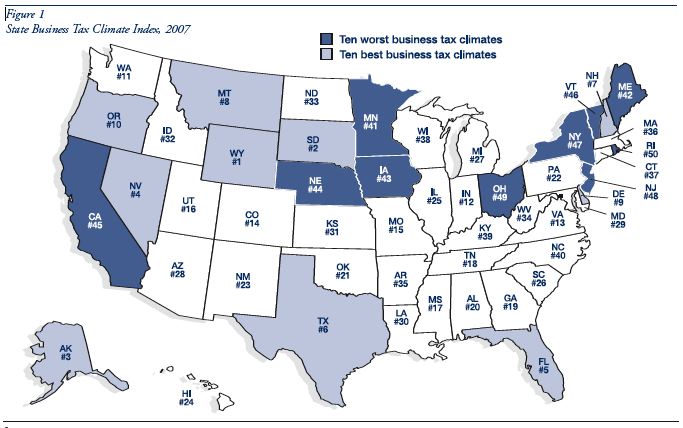
The Tax Foundation has released its annual State Business Tax Climate Index, so be prepared to hear from anti-tax critics that Minnesota ranks #41. The study tracks a variety of factors in the tax system that the foundation says contribute to a competitive business climate. The main categories and their weightings in the overall ranking are: 1. 29.15% —Individual Income Tax Index 2. 21.50% —Sales Tax Index 3. 19.43% —Corporate Tax Index 4. 15.72% —Property Tax Index 5. 14.20% —Unemployment Insurance Tax Index The states with the best rankings? 1. Wyoming 2. South Dakota 3. Alaska 4. Nevada 5. Florida 6. Texas 7. New Hampshire 8. Montana 9. Delaware 10. Oregon The bottom 10 include: 41. Minnesota 42. Maine 43. Iowa 44. Nebraska 45. California 46. Vermont 47. New York 48. New Jersey 49. Ohio 50. Rhode Island No argument here that taxes on business are not the best way to raise revenue, or that in theory, lower taxes on business should be good for the economy. But it's also important to look at the results of public investment in a state that benefit business. Business tax climate is not the same thing as business climate — which also benefits from public investment in education, health care, transportation, and quality of life. When we look at other comparisons, being #41 on the business tax list doesn't look so bad. Education. Morgan Quitno's rankings of "Smartest States" de-emphasize spending for public schools and instead measure states based on student achievement, positive outcomes, and personal attention from teachers.

As for higher education, put it this way. If you were taking a smart kid on a college tour, which 10 states would you start with? If your business relied on scientific research, where would you locate? Health. Morgan Quitno ranks healthiest states, too. Half of the top 10 business tax states rank in the bottom 11 healthy states. Work Environment. The Political Economy Research Institute's Work Environment Index considers job opportunities, job quality, and workplace fairness. Here, the top 10 rankings are equally divided with three states each — again, including Minnesota — but three business tax top 10 states also fall to the bottom of the WEI. We maintain that average income growth is a good measure of economic health. Unfortunately, the comparative data for states isn't very current. The Economic Policy Institute's analysis of economic trends through 1998 included top 10 lists for states that had a growing income gaps — between top and the middle and bottom earners. Half of the top 10 business tax states also showed up on at least one of the lists of states with the widest income gaps. One possible conclusion of all this: Best for business taxes doesn't necessarily mean best for everyone. And this: Take all state comparisons with a grain of salt.

----- -------- AUTHOR: Charlie Quimby TITLE: Is it a Tax or an Investment? DATE: 10/06/2006 04:54:00 PM ----- BODY:
[Note: Because the St. Cloud Times only archives its opinions for seven days, we've placed the full text of the linked article in our comments section.] St. Cloud Times Opinion editor Randy Krebs poses his question this way: "What's the difference between a tax and an investment?" It's a reasonable question, but he goes on to say:
Based on personal and professional experience, I've become convinced this is the ultimate unanswerable question, especially for politicians.
Actually, the answer isn't that tough. A tax is a revenue source. An investment is spending some of today's revenue with the expectation of a future return. This simple distinction has become complicated by 30 years of anti-tax rhetoric that made "tax" a word that can only be uttered with contempt. Especially during a political campaign. So, some politicians may use "investment" as a less toxic way to say we need to spend more. ("Spend," remember, is also a loaded term.) In his opinion piece, Krebs seems to agree, equating investment with more adequately funding education, transportation, and public safety. He's getting closer, but investment is not just a fancy word for spending on today's necessities. A wise investment requires a vision of the desired outcome, clear measures of success, and accountability for achieving results. Helping Minnesotans select good investments is what the "Invest for Real Prosperity" strategy is all about.
----- COMMENT: AUTHOR:Blogger Charlie Quimby DATE:10/09/2006 11:29:00 AM Krebs column:
Tax or investment? See what candidates say
Randy Krebs Opinion editor

Published: October 01. 2006 1:00AM

If you want to have fun with any of the political candidates knocking on your door these days — or heck, if you just want some lively dinner conversation — ask this question:

What's the difference between a tax and an investment?

Based on personal and professional experience, I've become convinced this is the ultimate unanswerable question, especially for politicians.

Which, of course, is why I encourage you to ask them.

Take, for example, education funding.

I have several friends and relatives who are retired. Every time their school district asks voters to kick in a little extra cash, they inevitably cite how they are living on a fixed income and that even having to pay a little bit more in taxes will be anything but easy.

Now, outside of the fact some of their incomes are "fixed" quite a bit higher than mine, I really can't quibble with their reluctance to raise their own taxes.

No doubt, they see this as a tax providing little direct benefit to them.

However, what they clearly see as tax looks much different from others' perspectives.

Take me, for example.

As a parent of young children, I'm routinely asked to buy school supplies my parents never had to provide when I was young.

And then there are my relatives and friends who are teachers. I swear on our family's tax returns that, yes, teachers do spend plenty of personal resources on public education.

Whether it's shopping garage sales for used board games to enliven learning or finding milkweed to keep science projects alive, I believe most teachers (and their families) just accept that shelling out their own resources is one of the simpler answers amid today's many educational challenges.

In fact, I think most teachers do this with little thought simply because they know there are much bigger classroom challenges in need of their time and attention.

Viewed from those perspectives, how can people not see referendums as much-needed investments?

But enough about education. The tax-or-investment question applies to many issues.

Look at transportation. Is the Northstar commuter rail project something that just sucks up tax dollars? Or is it a good investment considering there are no other transportation improvements planned anytime soon?

What about Minnesota's gas tax? Is increasing it simply putting your money into a black hole?

Or would you gladly pay if it meant more and better roads sooner than later?

And what about public safety? Are the extra dollars you will pay for expanding fire and police services really going to make your decades-old home safer?

Or is that an expense you should incur because it provides the same protections you have had for years to a new part of the city?

Tax or investment? Needed or not?

On Election Day, make sure you not only know how you would answer the question, but how the candidates you will vote for would answer it, too.

This is the opinion of Opinion Page Editor Randy Krebs. He can be reached at 255-8762. ----- -------- AUTHOR: Charlie Quimby TITLE: Is Productivity the Alternative to Increased Investment? DATE: 9/28/2006 11:49:00 AM ----- BODY:
Government can be more productive, some say. Wring out the inefficiencies, and we can fund more education, more healthcare and more transportation without raising taxes. Or hold the line while spending less. But often what we see as inefficiency is actually democracy at work. One man's meat is another man's pork. One community's essential project is another's waste. Working out these differences in a changing world is the business of government. In recent issues of the Minnesota Journal, Joel and the Citizens League's Sean Kershaw take up different aspects of the productivity question. Sean maintains it's more productive to focus first on "institutional innovations," rather than investing more in current institutions that have delivered questionable returns. [See his "The need for new and renewed institutions" viewpoint article here.] In "More investment and a more productive government," Joel responds that we can talk about investing more in education, health and infrastructure – and having a more productive government. Throw in raising the money fairly, and that's the essence of the Growth & Justice Invest for Real Prosperity strategy. Questions for Discussion. Is it time to declare the anti-tax forces victorious and move on? Or can we still have productive dialogue about how much government Minnesotans really want, and who will pay for it?
----- -------- AUTHOR: Charlie Quimby TITLE: Productivity's Rise Not Equally Shared DATE: 9/01/2006 10:18:00 AM ----- BODY:
A recent New York Times article reinforces several themes that we have been advancing as we present our "Invest for Real Prosperity" strategy.

The median hourly wage for American workers has declined 2 percent since 2003, after factoring in inflation. The drop has been especially notable, economists say, because productivity — the amount that an average worker produces in an hour and the basic wellspring of a nation’s living standards — has risen steadily over the same period.

As a result, wages and salaries now make up the lowest share of the nation’s gross domestic product since the government began recording the data in 1947, while corporate profits have climbed to their highest share since the 1960’s. UBS, the investment bank, recently described the current period as “the golden era of profitability.”

– Real Wages Fail to Match a Rise in Productivity, New York Times

The rise in productivity, along with the rise in average income, has been touted as evidence of a booming economy — both nationally and in Minnesota. But this is not real prosperity, which we hold is sustainable and widely shared.

Instead, we are settling into a period in which the benefits of economic growth are flowing disproportionately to corporations and wealthy individuals. The resulting prosperity gap is perhaps wider than at any time since the Gilded Age.

See the data from an analysis by the Minnesota Budget Project. Over the past two decades, the top 20% of earners have grown income much faster than the bottom and middle. If you were to look further up in the top 10%, the growth rate is even more dramatic. Growth rates for the upper 1% would be far off the top of the chart.

“Average” state income growth is distorted by this big growth at the top. The Times article documents the same effect on a national scale and notes how most Americans are falling behind in this so-called economic recovery:

Even for workers at the 90th percentile of earners — making about $80,000 a year — inflation has outpaced their pay increases over the last three years, according to the Labor Department.

“There are two economies out there,” Mr. Cook, the political analyst, said. “One has been just white hot, going great guns. Those are the people who have benefited from globalization, technology, greater productivity and higher corporate earnings.

“And then there’s the working stiffs,’’ he added, “who just don’t feel like they’re getting ahead despite the fact that they’re working very hard. And there are a lot more people in that group than the other group.”

We calculate that approximately 25% of Minnesota's families are not making enough to meet their basic needs. Many more in the middle are affected by wage deflation as their cost of living outstrips growth in their income. Critics of our Invest for Real Prosperity strategy call raising taxes on high earners an unfair redistribution of wealth. That's nothing like the redistribution that has been quietly occurring over the past decade.
----- -------- AUTHOR: Charlie Quimby TITLE: Investing for a More Competitive Minnesota DATE: 8/14/2006 09:39:00 PM ----- BODY:
Minnesota has long been a higher tax state, but that's not inherently bad -- it all depends on how we invest those resources. If our tax dollars are invested in the right public services, our competitive position is strengthened.
If you haven't read "Toward a more competitive state," by Jay Kiedrowski and John Gunyou, go there now. It's the best independent recap of the case for investment that we've seen.
----- -------- AUTHOR: Charlie Quimby TITLE: No Magic in Tax Cuts DATE: 8/06/2006 08:27:00 PM ----- BODY:
State Sen. Larry Pogemiller, chair of the Senate Tax Committee, comments in the Star Tribune on the simplistic views held by critics of state spending.

Through selective use of information, Michael Wigley and William Cooper portray a world in which tax cuts magically result in increased government revenue and a million flowers bloom ("Tax cuts are benefiting our economy," July 23). Unfortunately, the real world is less rosy and more complicated than they would have us believe.

They are correct in noting that capital gains tax collections are up, but mistakenly, in my judgment, attribute the growth to tax cuts. Federal capital gains tax revenue increased more rapidly during the Clinton years -- when taxes were increased -- than in either the Reagan years or the present Bush years, when taxes were cut.

To simplistically link the growth in capital gains revenue to tax cuts seems to ignore the historical record. One needs to take into account a complex array of forces influencing capital gains tax collections.

----- -------- AUTHOR: Charlie Quimby TITLE: Taxes in the News DATE: 8/03/2006 05:14:00 PM ----- BODY:
A caller asks: Do "no new tax" pledges tie the hands of leaders who have to plan for the future? Sometimes the answer depends not on political philosophy, but on level of government. Endorsed candidates for governor say they won't raise taxes, but the state largely relies on funding sources — income and sales taxes — that rise when the economy rises. Local governments don't have that benefit; they must set a spending level and levy the tax to meet the budget. In case you missed it today, this is part of the discussion on MPR's Midday. The program hosted David Strom, President of the Taxpayers League of Minnesota, and Minnesota state representative Paul Marquart (DFL-Dillworth), a leading member of the House Tax Committee. St. Paul Mayor Chris Coleman posted a city budget cruncher tool to illustrate the challenge he faced. Yesterday, he proposed a tax increase as part of his plan to solve the city's $16.5 million budget gap. His finance and budget director, Matt Smith, answers questions in today's Pioneer Press.
----- COMMENT: AUTHOR:Blogger Justin C. Adams DATE:8/04/2006 06:12:00 AM Also, in case you missed it, on the Midday program, Mr. Strom stated that state and local taxes are progressive.

This disagrees with our most recent tax incidence study, published 2005, which states that taxation in our state is regressive, that we are trending more regressive over time, and that the top 1% of our state's earners pay only 8.4% of their income to state and local taxes while the bottom 10% pay 16.3%

These figures do not include the recent stadium tax or the Governor's health impact fee, nor many other regressive measures that have been adopted over the past two years.

The central issue is not 'how much', though we clearly can no longer afford to provide the level of investment we would need to make Minnesota the best place to raise a family.

Rather, the issue is 'who pays'. Taxes raised on the back of the poorest taxpayers decrease class mobility and re-inforce the social and economic inequities in our system.

It is widely believed that taxing the wealthy at a rate proporational to the economic benefit they receive under the protection of the state would drive the best and brightest from our state. I would argue that if our schools were the best in the nation and if companies operating here did not have to bear the cost of health insurance, we would have a very high level of growth.

Besides, putting more money in the hands of a family with a household income near the bottom of the range spurs economic growth. Whereas the wealthy can hold the extra money waiting for a good investment oppurtunity, the poor will spend.

This spending 1) creates growth and 2) sends the money to the top wage earners anyway. ----- -------- AUTHOR: Charlie Quimby TITLE: Health Cabinet Study Points Up Need for Strategic View of State Finances DATE: 7/28/2006 06:22:00 PM ----- BODY:
Give the Pawlenty administration a little credit. It's at least looking at covering the state's uninsured, even if the cost makes them blink.

Gov. Pawlenty's Health Cabinet requested the Health Department to look at the cost of adding 383,000 people to the publicly subsidized MinnesotaCare program, and another scenario that relies on private insurance to cover the state's uninsured.

On the low end, it would cost about $663 million a year, and on the high end, more than $850 million.

As MPR reports:

[Health Cabinet] Chairman Cal Ludeman says the cabinet just wanted the information. He says it doesn't imply that the cabinet endorses universal coverage. "No, no, no," he says. "We want to know what it would be, what it could potentially cost if we're going to have the debate about it. That's what it is, and that's all it is."

Ludeman points out that the debate over universal coverage has been a part of legislative discussion for years. But he says the idea has taken on more momentum lately.

"We don't do this in a vacuum. We're fully aware of proposals in this Legislature," says Ludeman. "We've watched carefully the actions in Massachusetts, have talked to people in Massachusetts both legislatively and those folks trying to implement that universal coverage program. This is just simply an assessment of the situation to understand that whole picture."

Ludeman says his first reaction to the estimates, which range from $663 million to $852 million, is that they sound big.

"Some will say, 'Boy, that's not as big a number as I thought and let's do it,'" says Ludeman. "But a lot of folks would say, 'Wait a minute, this is a new entry in a government or taxpayer sense about where we're going, and that is a lot of money.' And I think as you look at the state budget, this sort of new cost would always be viewed as a lot of money."

Exactly why we need a fiscal framework that looks strategically at state finance.
----- -------- AUTHOR: Charlie Quimby TITLE: Join the Discussion DATE: 7/26/2006 12:10:00 PM ----- BODY:
Our Invest for Real Prosperity strategy continues to attract critiques. Some of it is balanced. See what the Citizen League's Sean Kershaw posts on his blog (positive here, critical here, and both here.) Then there's Sarah Janecek’s distorted view of How the Growth & Justice tax increase would hit singles, where she fastens on a single point about taxes and bolsters her view with mistaken assumptions that yield erroneous math. For starters, she claims many single-person Minnesota households make between $45,000 and $75,000 a year. She's not technically wrong, because "many" is an imprecise word. However, since 80% of singles earn under $50,000 annual adjusted gross income, her "many" may be a lot smaller than your "many." That's also why we feel confident that more than half of single filers would owe no additional income tax under the proposal. Worse, she claims our proposal would raise the rate on the lowest income tax bracket. It does not. The rate stays at 5.35%. That's why almost half of all Minnesotans see no income tax increase under the proposal. The rest of her figures are wrong as well. Most important, she ignores the real point of the proposal: How wise state investment in people and places can build economic capacity. If you want to join informed discussion about real prosperity, comment here and over at Sean's blog.
----- COMMENT: AUTHOR:Blogger Charlie Quimby DATE:7/26/2006 09:17:00 PM A minor expansion on the point about how many are affected:

13% of single Minnesota taxpayers earn between $50k and $75k. So that means "many" is 13% of Minnesota singles plus how ever many earn between $45k and $50k. ----- -------- AUTHOR: Charlie Quimby TITLE: Is State Spending Going Up or Down? DATE: 7/25/2006 11:46:00 PM ----- BODY:
You’ve heard the sound bite: “We don’t have a revenue problem. We have a spending problem.” A few days ago, Bill Cooper and Michael Wigley of the Taxpayers League hauled out some numbers to support this claim, saying state revenues have grown by 8.7%. First, we question their figure. They say the state collected $15.5 billion in FY 2006. The state general fund current resources were $14.65 billion for FY 2005. That’s a difference of 5.8%, which is less than the inflation rate on what government needs to buy during that period. Figured an alternate way, growth could be as high as 7.6%. More important, look at state expenditures over the past four years. After adjusting for inflation and the state takeover of general education and transit, which increased state costs but lowered local costs, the effective difference between FY 2002-03 and the coming fiscal year is a per capita decline of 6.8%. With all the state cost shifts and funding cuts to local government, comparing numbers gets confusing fast. And that’s what anti-tax advocates want – for voters to gravitate to the simple message that spending is out of control. So let’s keep it simple. While demands on state government keep increasing*, real per capita state general fund spending has been falling. Minnesota does have a spending problem: State spending has not kept pace with demand. *Growth in the number of special ed kids and those with limited English, new federal testing requirements on schools, new homeland security costs, increasing healthcare costs due to an aging population, etc.
----- COMMENT: AUTHOR:Blogger Charlie Quimby DATE:7/27/2006 08:55:00 PM [Moderator note: I received this commentary directly from Miles Spicer, a retired ad agency owner. It is posted with his permission.]

Surprise, surprise! In a July 23 editorial, William Cooper (chairman of TCF Financial Corp) and Michael Wigley of the Taxpayers League, claim tax cuts have lifted the economy and sent "gushers" of money into state (and national) coffers. Huh?

Well, starting at the Federal level, if tax collections have risen so dramatically, why are we running record deficits that are empowering foreign governments who lend us money; and encumbering our next generation(s) with horrendous amounts of debt and interest? Indeed, the strong rationale of the first Bush tax cuts, were we told, was we could afford them because of the generous surpluses created during the Clinton administration. Well, the Bush people surely solved that problem. They evaporated those surpluses in a very few years – then went on to send us into serious negative territory.

And, at the state level, if we are so flush with bucks, why are so many of our facilities and services still so underfunded? In the Star Tribune on Monday the 24th, there was a major article about the inability of the state to improve vital Highway 53 in northern Minnesota, due to lack of funds; and everyone driving the mess on the Crosstown wonders why that project is stalled. As a third generation Minnesotan, it is clear to me that this state's services have declined in many dimensions under the present leadership.

But that is not the worst part of the Cooper premise. The worst part is that the tax cuts have been incredibly unfair, disproportionate and favoring the wealthy. In 2004 (the latest year numbers are available) the real average income for the top 1% of households (those making $315,000+) grew by 17%. For the remaining 99% the average gain was less than 3%. And that is on top of a gain for the wealthy of over 20% in 2003, according to data, mostly from the Census Bureau. What is more, the top 10% of households last year had 46% of the nation's income; with the bottom 90% sharing about 56%. The top 1% alone had 19.5% with the other 99% of us sharing the rest; and they accounted for over 33% of the total net worth (wonder why they oppose the estate tax?). Exacerbating this maldistribution of wealth in our country is the aforementioned tax cuts.

Here's the data on tax cuts according to recent government data. The average tax cut for households of more than $1 million (the top two tenths of 1%) is $112,000 – or a boost of after tax income of 5.7%. The middle fifth of households gained 2.5% in tax relief (about half that of the very top earners). But sadly, the poorest fifth gained only 0.3%. No wonder rich folk like these new Bush tax laws! And there is not much relief for the poor in our country with other Bush policies; earlier this year he signed into law cuts of $39 billion in domestic programs like Medicaid and food stamps. I do not see the "money-spending machine in Congress" Messers Cooper and Wigley refer to – unless they are referring to the outrageous cost of the Iraqi war.

Now if this seems like I am assaulting capitalism, nothing could be further from the truth. I owned my own successful businesses for over 45 years. Capitalism has been good to me. Egregious as this inequality is, capitalism works. But, it works best when there is a more fair distribution of wealth; when the middle class has a stronger position; and when the poor have reasonable disposable income. Indeed, the minimum wage ($5.15) has not been raised since 1997 – a fact that is not only unfair, but does not appear to me to foster economic vitality.

No, I cannot agree with any premise in the July 23 editorial. Tax cuts have not necessarily improved the economy; they have created terrible national debt; nor have they improved the lot of average Americans. And worst of all, they have decidedly made the rich richer, and the poor poorer; and that does not serve our state well, nor the Federal government – or capitalism for that matter.


Myles Spicer
Minnetonka,
Retired Ad Agency Owner ----- COMMENT: AUTHOR:Blogger Charlie Quimby DATE:7/27/2006 08:58:00 PM Growth and Justice takes the position, too, that capitalism benefits from an economy that benefits people at all levels, and raises money for public investment fairly from all levels. ----- -------- AUTHOR: Charlie Quimby TITLE: What’s the real difference between Wisconsin and Minnesota? DATE: 7/25/2006 10:35:00 PM ----- BODY:
To bolster his contention that Minnesota taxes are too high, former GOP party chair Bill Cooper has more than once made the point that Minnesota collects more tax money than Wisconsin, though Wisconsin has 400,000 more people. Sounds bad. But the claim is actually just a bad comparison, says policy analyst Jeff Van Wychen who has looked at how government spending compares across states:
“A much larger share of general education funding is paid for at the state level in Minnesota than in Wisconsin, due to the state takeover of general education.”
In fact, the Republican party, Taxpayers League and most progressives all supported the change in how the state
paid for education, because it encourages more fairness in the system and was supposed to relieve the property tax burden. So let's not use a good policy to make it look like spending is up when it's just been shifted from the local level to the state. A more appropriate comparison would be based on the percentage of average personal income spent by all government — state and local government plus federal dollars spent in the state. By this measure, Minnesota has fallen to 36th among the 50 states based on 2004 data. And we haven’t been heading upward since. Wisconsin? It ranks 15th.
----- -------- AUTHOR: Charlie Quimby TITLE: Looking Beyond the Boom DATE: 7/20/2006 12:45:00 PM ----- BODY:

Here are some interesting facts about Wyoming. It’s likely to have a $1.8 billion budget surplus next year, even though state spending has jumped by more than 50 percent in the past two years. In the past quarter, Wyoming had the highest per-capita income growth rate in the nation and the third lowest unemployment. It usually ranks at the top of the “best business climate” charts, because it has no personal or corporate income taxes. [...] The other interesting fact, of course, is that the country wants a lot more of what Wyoming has in abundance — coal and natural gas — and is willing to pay for it. The price of natural gas at the wellhead has gone up by more than 150 percent in the past seven years, often spiking much higher. That, coupled with the Bush administration’s freewheeling approach to energy development, has resulted in a petroleum boom that is transforming the state.

[...]

[T]o its credit, the state is trying to find a way to feed some of its revenue into programs that will help even out the shock when the boom busts — or simply tapers off. It is putting large sums into its Permanent Mineral Trust Fund, which collects a portion of the severance tax paid for Wyoming minerals, and it is adding to what it calls its Legislative Stabilization Reserve, a temporary savings account. The state has at last created a wildlife trust fund first proposed in 1982 but regularly defeated in the State Legislature, and it has endowed scholarship programs and the building of new schools.

It’s hard to argue with prosperity, but a lot of people in Wyoming are worrying about its ultimate costs.

– "Boom Times in Wyoming, and Worrying Times as Well," Verlyn Klinkenborg, NYT

Good for them. At least with mining and gas production, Wyoming's citizens can see the scars created by the temporary prosperity machine and are building up a little insurance.

With our Minnesota economy based on knowledge — instead of mineral extraction and $25-an-hour water truck drivers — the investments we make today determine how educated, healthy and productive our workforce will be two decades from now. It's harder to see that future through the fog thrown up by anti-tax advocates and the politicians who love them.

But public infrastructure is also vital to a productive economy and it's tangible. So how are we doing there?

The American Society of Civil Engineers — not yet branded as a notorious left-wing think tank — publishes a state-by-state report card on the condition of America's infrastructure. You can read it here.

Not a strip mine filled with noxious chemicals, but not a pretty picture, either.

[Note: A version of this was cross-posted at Across the Great Divide.]

----- -------- AUTHOR: Charlie Quimby TITLE: Calculating the Cost of Tax Cuts DATE: 7/19/2006 12:15:00 PM ----- BODY:
Last month, Citizens for Tax Justice (CTJ) published an analysis that looked at how federal tax cuts between 2001 and 2006 have affected taxpayers in each state. Most can take small comfort in any tax break they've received, says CTJ, because they'll pay for it later. CTJ argues that these tax cuts — most recently providing temporary capital gains and dividends tax cuts plus AMT relief — are being paid for with borrowed money, since there's been no offsetting reduction in federal spending. In fact, the rapid rise in defense spending has further enlarged the gap that has to be filled. According to CTJ's calculation, the average middle-income Minnesota family has received an average federal tax cut over six years worth $2,236 per family member. But it puts the family's share of the increased national debt at $9,679 per person, for a net debt of $7,443. (See here for the gory details on how tax cuts by state and income group were calculated.) Of course, there's a certain amount of false precision in the per-person debt total, no matter how it was figured. And it's important to note that this caution about debt applies to federal tax cuts, not state cuts. Minnesota is required by constitution to have a balanced budget, so all state borrowing relates to bonding for specific projects. Still, assigning a debt price tag works as another way to dramatize how so-called tax relief is almost never what it seems. Tax cuts come with an eventual cost, whether government cuts services, takes on debt, shifts costs or dis-invests. So before celebrating your reduced taxes, remember the burden doesn't go away, it just goes somewhere else.
----- -------- AUTHOR: Charlie Quimby TITLE: Not Just "Counterintuitive." Supply-side is Wrong. DATE: 7/12/2006 08:16:00 AM ----- BODY:
Recent government surpluses are encouraging the resurgence of a persistent myth. The latest claim that tax cuts actually grow government revenues came in a letter from Dan Cohen to the Star Tribune.
Despite last year's projections that Minnesota would once again face a deficit, we are running a surplus, while at the same time our state no longer ranks in the top four or five in per capita taxation but has dropped to 16th. In Rhode Island, about a blue a state as you can get, the top tax rate has been cut from 9.9 percent to 5.5 percent, and the state has gone from the third-highest individual income tax rate to the 27th. According to William Murphy, the Democratic House speaker, to the business leaders who choose where their companies move and create jobs, the tax rate makes a big difference. In New Mexico, Democratic Gov. Bill Richardson has cut the top income tax rate in half. New Mexico now has a half-billon-dollar surplus and has seen tax revenues increase by 27 percent this year, faster than any other state in the union.

Yes, it's counterintuitive to claim that lowering taxes increases tax revenues. But it does, not only because it attracts more businesses and jobs. It's also because the more money people have to spend on themselves rather than have confiscated by government, the more those dollars circulate to generate greater demand for goods and services, the more jobs that are created to supply those goods and services and the more income that is spread among more people -- and thus, more tax revenue.

–Dan Cohen

Joel Kramer consulted with the New Mexico tax department's chief economist and responded in today's Star Tribune, excerpted here.
Cohen claimed that New Mexico cut its top income tax rate in half. Actually, they are phasing in a cut of 40%, but so far it’s only about 30%. More significantly, Cohen claimed that New Mexico’s state tax revenue rose by 27% in one year after the tax cut. But the state’s own data for the past two fiscal years show that the general fund, which includes all the major state taxes, grew only 7.7% and then an estimated 6.3% -- about one-fourth the annual rate of growth that Cohen claimed. Okay, his "facts" don’t match what the government reports, but New Mexico did show some growth after cutting the income tax – so is Cohen right to assert that the tax cut caused the revenue growth? Absolutely not. New Mexico is a major producer of oil and natural gas, and a spike in the price of oil and gas boosted the taxes and lease fees on production in the state by 38% this year (on top of about 30% the year before). This leap explains all the growth in New Mexico’s revenue – personal income tax collections actually dropped this year. The supply-side theory Cohen is selling – that tax cuts create enough economic growth to more than pay for themselves – failed during the administration of President Reagan and is failing again under George W. Bush, resulting both times in skyrocketing national debt. And Minnesota’s tax cuts in the late 90s failed, too – creating a fiscal crisis and a slower-growing economy.
Want more to counter the tax-cut myths? See the earlier posts here and attend one of the upcoming Invest for Real Prosperity information sessions.
----- COMMENT: AUTHOR:Blogger Charlie Quimby DATE:7/12/2006 11:18:00 AM I've said this before, but I'll say it again.

Those who say "tax-more, spend-more" policies stunt job growth seem to think the money the government collects goes nowhere — or maybe into a coffee can buried in the Boundary Waters.

Actually, it goes to schools, public works and infrastructure projects. Jobs. It goes to hiring more highway patrol, police and fire fighters. Jobs. It hires more teachers and social workers and librarians. Jobs.

And what do they think happens when they continue to cut government spending? It can't come out of the paper clip and coffee budget because that money's long gone. ----- -------- AUTHOR: Charlie Quimby TITLE: Federal Tax Cut Lessons Apply to Minnesota DATE: 5/12/2006 05:10:00 PM ----- BODY:
The recent extension by Congress of the Bush tax cuts on investment income is deeply irresponsible, both because we can't afford tax cuts when the deficit is ballooning and because this particular provision so overwhelmingly favors the very wealthy. These two editorials from the NYT vividly make the point: Tax Cuts for a Favored Few Tax Increases for Everyone Else There are important lessons here that apply to Minnesota's tax situation as well. First, beware of tax-cutters citing "averages." Supporters say this bill, for example, will cut the average American's tax bill by over $400. But only people earning well over $100,000 a year would get that average or better. People earning $1 million a year would save about $42,700, and reap about 22 percent of the total tax cut, according to the Tax Policy Center, a research group in Washington. People earning $40,000 to $50,000 a year would save about $47 and receive less than 1 percent of the benefits. The difference between the mean and the median may seem like arcane statistical mumbo-jumbo to a lot of people, but it's the key to understanding tax fairness. In Minnesota, the average (or mean) tax share is about 11% – which means that about 11 cents of every dollar earned by Minnesotans goes to state and local taxes. But for the median family – half make more, half less – that share is about 12%. And for the wealthiest 1% of households, it's only 8.5 cents on the dollar. Second, beware of tax-cutters telling you that lowering taxes on investors strengthens economic growth and pays for itself. The Times editorial called his "seriously delusional." As the Times explains it, economic theory says it should be true, all other things being equal. But all other things are never equal. At the federal level, the tax cuts increase the deficit. At the state level, they lead to cuts in spending on such things as education and transportation — which are building blocks of economic growth. That's why the real-world evidence does not support the theory that lower taxes (especially on the wealthy) create more economic growth. What they created in Washington this week was a $40,000-plus windfall for people earning more than $1 million a year. – Joel Kramer, Growth and Justice
----- COMMENT: AUTHOR:Blogger Charlie Quimby DATE:5/12/2006 05:39:00 PM You may know the classic illustration of the Tax Cutter's Law of Averages.

Economist Paul Krugman puts it this way:

Say 10 middle-class guys are sitting in a bar. Then the richest guy leaves, and Bill Gates walks in. Because the richest guy in the bar is now much richer than before, the average income in the bar soars. But the income of the nine men who aren't Bill Gates hasn't increased, and no amount of repeating "But average income is up!" will convince them that they're better off. ----- COMMENT: AUTHOR:Blogger Mark DATE:6/23/2006 03:37:00 AM Mr. Kramer, if ever you need a dissenting viewpoint, if ever you find yourself thinking aloud, "Gee, I wonder what others beyond my cadre of fellow lefties thinks on this topic," well look no further then my blog:

http://www.latenightrants.blogspot.com/

There you will surely find all the opposing views you care to stomach.

Thank you.

Mark Lentz, Late Night Rants ----- COMMENT: AUTHOR:Blogger Meangoose DATE:6/26/2006 04:45:00 PM Wow - this is pretty amazing.

I'd just like to point out, for all those dissenters, that no matter how hard they worked/work/will work to pay for their house/family needs/etc., they don't do it alone. People who yell, "Don't rob my pocketbook to pay for the poor" are being narrow-sighted and selfish.

How do you drive to your job? Did the state just magic-up a road? No, taxes pay for that road. How do you have the safety to walk to the store? Taxes pay for police, and taxes pay for programs that make a life of crime a less attrative option (amazing, sometimes, not in a punitive fashion, but in a positive fashion) for people who are less fortunate than you. Do you really want to live in a country where poor children mob others begging for money or food? I'm guessing not. Social programs prevent that.

How do you know the food you work so hard to buy is safe for you to eat? Taxes pay for the governement to check. The examples go on and on. Wake up, Minnesotans, and pay a fair share to maintain a good quality of life for all of us. ----- -------- AUTHOR: Charlie Quimby TITLE: Getting off the Roller Coaster DATE: 5/09/2006 12:07:00 PM ----- BODY:
Can government introduce more stability to state finances? Government budgets are inevitably tied to economic growth. When times are good, revenues rise and governments hear competing calls — for cutting taxes, increasing spending and creating reserves. When times are bad, governments face cutting services and raising taxes or fees. According to the Center on Budget and Policy Priorities (CBPP), states later regret it when they cut taxes and draw down reserves. CBPP found that in 1999, eight of the 48 contiguous states had adequate reserves to maintain services in a recession without increasing taxes. A year later, five of the eight, including Minnesota, enacted tax cuts that erased the margin of safety. When the economy began to weaken a year later, the “big tax-cutting states generally faced larger fiscal problems, and had worse economic performance, than other states that had been more cautious about tax cuts.” We cannot repeal the business cycle, but we can get off the roller coaster that often accompanies it. Further Reading: Tax Cuts and Consequences: The States That Cut Taxes the Most During the 1990s Have Suffered Lately Georgia’s Revenue Shortfall Reserve What do you think? 1. How might the state better protect reserves or “rainy day funds” created during times of revenue growth? 2. What is the best use for limited “surplus” funds — making future investments in areas such as education and infrastructure, or maintaining reserves against future shortfalls?
----- COMMENT: AUTHOR:Blogger Charlie Quimby DATE:5/09/2006 10:32:00 PM 1. Non-profits develop reserve funds that enable them to weather cycles in funding or operational cash flow. The funds may be drawn upon, but are also expected to be replenished within a given period. This practice provides a measure of security during down times, but also enforces long-term fiscal discipline.

Families do the same thing (at least, well-run families do), keeping a cash reserve for emergencies. But non-profits and families tend to have more consistent leadership and values that encourage the practice of good financial stewardship. Government suffers under successive political regimes that may see a previous administration's prudence as unjustly holding on to money the taxpayer could be spending.

I'd support creation of a reserve fund set as a percentage of the state budget, to be used to balance annual budgets or cover for temporary funding shortfalls. But any money disbursed from the fund must be repaid within a year or two. It could not be used to cover for tax cuts or to allow shifting of costs that could otherwise be funded.

How to set up such a fund that couldn't be raided or run to empty by politicians who object to government spending is the real problem, though, and for that I don't have an answer. ----- COMMENT: AUTHOR:Blogger Charlie Quimby DATE:7/05/2006 05:17:00 PM Moderator is re-posting this comment for Kent Ficarra. A previous post on 6/28 went astray when I sent it....

I just read your comment so this is off the top of my head. What about passing a law which links the state reserve fund to the Federal Governments Index of Leading Economic Indicators (LEI's). When the indicators predict an economic downturn, the state would start spending from the reserve. When the indicators predicted a rebound,
the state would start restoring the fund to its statutorily required level. The size of the fund would be revised each year to take into account inflation, population and economic growth and any other factors that experts would determine are relevant. In theory this would prevent politicians from raiding or otherwise misusing the fund since there would be no discretion regarding when to withdraw and return money to the fund. Everything would have to be done according to a predetermined formula.

I would like to know what you think of this idea. If no good as presented do you think it could be massaged into something valid?

I am a firm believer in Keynesian theory so we are on the same page of the hymnbook. I once heard an interview with Milton Friedman in which he said that "Keynes was a socialist". I guess that means we are both socialists. Don't worry I wont tell anyone.

Sincerely,

Kent T. Ficarra ----- COMMENT: AUTHOR:Blogger Charlie Quimby DATE:7/05/2006 05:26:00 PM Kent Ficarra has an interesting idea. I don’t know whether the LEIs are accurate enough predictors for this to work, but in any case, I think that a formula that eliminates (or at least minimizes ) discretion is an excellent idea.

The way we were thinking about it was after the fact rather than predictively: in other words, any year in which tax revenues grow by more than population and inflation growth, some money should be added to reserves, and any year in which revenues trail population plus inflation growth is a year when reserves can be drawn down.

Joel Kramer ----- -------- AUTHOR: Charlie Quimby TITLE: Honest Tax Talk DATE: 5/02/2006 07:01:00 AM ----- BODY:
Should candidates talk candidly about raising taxes? Raising taxes may be the best way to address the state's needs, but only some candidates are courageous enough to say it. Talk of financing state services tends to be dominated by other voices: Candidates who pledge not to raise taxes, promise to lower them, or dodge the question by talking about increased revenue from economic growth. So what happens when revenues fall far short of what's needed to provide services the people want and expect from government? Officials may try to create desired programs while concealing, shifting or delaying the cost — or they may cut programs and claim that service will not suffer. But the public isn't fooled for long. Sooner or later, the impact of all the cutting and shifting becomes painfully apparent. Further Reading: What Governor Gregoire said — and did Parsing Kaine: Did He Mean 'No New Taxes'? Corzine considers tax increase on alcohol sales Minnesota not giving up on cigarette fee What do you think? 1. If candidates favor raising revenue through a tax increase, should they take that message to the voters — or wait and work for an increase after the election? 2. How would you make a winning case for higher taxes in a campaign? 3. How might Minnesota encourage a more honest framework for discussing financing of state and local government?
----- COMMENT: AUTHOR:Blogger Charlie Quimby DATE:5/02/2006 07:53:00 AM 1. If candidates favor raising revenue through a tax increase, should they take that message to the voters — or wait and work for an increase after the election?

We have too many examples of politicians willing to "spend and not tax." Voters will eventually get tired of this.

If a candidate supports government action that will cost more money, it's responsible to talk about the financial realities. And being elected on a platform that calls for a tax increase would certainly make that official more effective during the legislative process.

The challenge, of course, is first getting elected.

Answering the "how will you pay for it?" question offers a vital test of any proposal. Yet responding to the question rarely leads to serious discussion about the need being addressed or the merits of the solution. Opposing campaigns jump on the higher cost and attack at the soundbite level.

You can see how this sort of thing works in the Mark Kennedy attack on Amy Klobuchar's expanded health care position. There's no substantive discussion about the problem.

Candidates run as individuals, but govern as part of a collective. It's rare that any single candidate's position would make it intact through the give and take of the legislative process.

So I think one way for candidates to make their case (question 2) is to clearly define the problem, acknowledge that paying for it is a concern, and invite opponents' proposals on how to solve it. ----- COMMENT: AUTHOR:Blogger Justin C. Adams DATE:7/27/2006 09:37:00 PM Here's my proposal - and I am on the ballot as an independent candidate for the MN House in North Minneapolis.

The problem is the regressive tax code itself. I am tired of politicians who talk about family values but return nothing of value to my family. The median household in my district has an income of 37k.

They will pay 11.8% of that to taxes in 2007, while the top 5% will pay only 8.4%. Yet we passed another sales tax - to buy a stadium for one of these 8.4% types. Here is my proposal to fix the problem.

I support increasing the income tax by 9 billion dollars. Roughly 5 billion dollars would be used to fund state and local programs currently funded with the general sales tax and with property taxes on homesteads worth less than $250,000. Primary residences over this value would pay property tax on the margin.

This will deliver an effective tax cut to well over two thirds of MN households - more importantly, it will deliver the largest tax cuts to those who need them most. These individuals will spend the money, delivering the growth that would never occur from a supply-side designed tax cut.

This first $5 billion is not a tax hike, just a tax redistribution.

Once the regressive tax problem is solved, the state will be in a much better position to fund initiaves like G & J recommend. I favor more expansive programs than G & J has proposed - 4 billion in additional spending to fund universal high-quality education from age 3-23, MN wide single-payer universal healthcare, transit, especially expanded mass transportation, and public safety.

Ours used to be the very best state to raise a family. This fact alone permitted the overly robust northern economy that we have enjoyed for much of my life.

My plan will not only restore MN to its rightful place on the top of our nation's best places to live, but also deliver something of real value to minnesota families. ----- -------- AUTHOR: Charlie Quimby TITLE: Investing Strategically DATE: 4/19/2006 09:13:00 AM ----- BODY:
Has state government forgotten the difference between spending and investing? Some advocates of smaller government encourage us to think of the state budget like the family budget. We all must live within our means, we are reminded, which may require us to tighten our belts and lower our sights. You can almost hear mom and dad explaining to the kids why there will be more Hamburger Helper, less ice cream, and no trip to Disney World this year. Many Minnesotans don’t realize it, but as a share of our income, what we spend on government has shrunk from a decade ago, thanks to the No-New-Taxes pledge. This shrinkage of government explains our constant state of fiscal crisis and inadequate resources to do what the people clearly want done. Another unfortunate side effect: A spending-only-on-necessities mindset develops, with a focus on long-term expenditure controls, not on long-term investment. Investing in the future becomes a discretionary expense, reserved for better times. Yet when fiscal conditions improve, we hear demands to return the “excess” to the taxpayer, who can better invest the money. In education, public health and safety, transportation and the environment, the bar goes lower and lower until the consequences of deferred investment are impossible to ignore. The state does allocate funding for public buildings, infrastructure and land acquisition — investing in our physical capital. But it has become less generous in investing in the human capital that increases the capacity of individuals and their families to earn a living and contribute to society. One argument against state investment in families is that families understand their needs and can invest the money more effectively than government. But not all families have the same priorities or capacity to invest in their children. Government employs three common approaches to investment: Universal free access (like K-12 education); highly targeted support to those in need (like food stamps); or a hybrid model (like higher ed) that seeks universal access by combining spending on institutions with some financial support for families — all the way up into the middle class. Further reading: Why has Minnesota stopped investing in education? State doesn’t ‘invest’; it spends Spend: a liberal economic program Governor Tim Pawlenty’s 2006 Capital Budget Recommendations How investing in education pays off What do you think? 1. Although investment may be directed to one need, positive outcomes can overlap. Investment in education correlates with higher income and reduced incarceration. Investment in smart growth transportation can lead to reduced commute times and fewer fatalities. Given a limited amount to invest, where would you direct Minnesota’s investment over the next 10 years? 2. Which of the three investment models described above would you favor, and why? 3. It’s comparatively easy to see when the budget balances. How can we best determine if our investments are paying off?
----- COMMENT: AUTHOR:Blogger L-Dawg DATE:4/20/2006 04:05:00 PM There is a very strong case for the economic return on investment in early childhood education. Major research on this is coming out of the Federal Reserve Bank of Minneapolis (of all places). It would make a lot of sense to invest in this...
http://minneapolisfed.org/research/studies/earlychild/#ecd ----- COMMENT: AUTHOR:Blogger Eli Kramer DATE:4/21/2006 04:10:00 PM Minnesota should use its investment dollars to pursue the goal of becoming a nation-wide leader in decreasing the rapidly growing wealth and income inequality that we see in the United States. The trends in these areas on a national level should not be considered an acceptable direction, and Minnesota values dictate that changing the tides would be well worth the taxpayers' investment--not to mention that leveling the playing field could actually provide great benefit to Minnesota's economy.

If decreasing wealth and income inequality were the goal, the direction of the investment (as well as some not-spending efforts) might include: (1) spending more on education for middle and lower-income groups that will lead to living wage jobs, (2) encouraging employers, with incentives, to create living wage jobs, (3) promote socially responsible business practices that close the absurd gap in CEO and worker spending, (4)increase spending in the area of helping people become first-time homeowners (in open-market housing situation i.e. not low or mixed income zoning), (5) making access to health care universal and affordable. ----- COMMENT: AUTHOR:Blogger spendwisely DATE:4/23/2006 12:08:00 PM There is enough money invested in schools, however, it is spent so incredibly inefficiently and poorly that it's criminal -- almost literally. Two cases in point:

1) There are more than 400 school districts in MN. Except for a handful, they all use their own back end office systems for reporting, payroll, vacation processing, etc. If they were to consolidate into a single, statewide system, the savings is estimated to be more than $500 million – PER YEAR! You think we could use that money to pay for more teachers, bring back the arts and music into schools, etc.? Or is that money better spent the way it currently is, supporting outdated technology and the salaries of administrators who run these outdated systems?

2) In the city of Minneapolis, the teacher’s pension fund is under funded by nearly $600 million. In this legislative session, there is likely to be a bill introduced for the state to pick up the tab. Here’s the interesting part. The city has an investment policy statement agreed to by a committee that clearly states how the pension monies should be invested. If the committee had followed their own statement, the pension fund would be close to even. However, they did not follow their own written guidelines and thus invested in risky investments. Now, money that could have gone to support education is now going to pay for the almost criminal mismanagement of pension funds. Is anyone being held accountable? Of course not. You want to know the really sick part? In the majority of school districts in MN, the exact same thing is happening; “expert” money managers are not providing value versus if the money would have just been stuck into Index funds and left alone to grow. Instead, these money managers are earning millions of dollars in fees (if consolidated statewide) and are providing little if any value.

The issue is not that we don’t have enough revenue to support a first rate school system. The issue is that the money that is there is being wasted and no one seems to want to do anything about it. No one is being held accountable. Instead of fixing the underlying issues, we just keep throwing more money at a broken system.

Sam Richter ----- COMMENT: AUTHOR:Blogger CatMan DATE:6/22/2006 10:41:00 AM I agree that money in schools could be spent more wisely -- as in any other business. I suppose it could be argued that everywhere, all the time, money could be spent more wisely.

Perhaps if school systems could afford to hire the best financial managers and superitendents, they wouldn't have such mismanagement of funds? But if you are the best qualified, most experienced finanical manager or business CEO or CFO, why on earth would you ever work for school district? You could get paid much more working in the private sector. Why are superintendents so hard to find these days? Who would want such a political, pressure-filled job when they have they could avoid the nasty politics and public criticism and earn more pay as a CFO or CEO of a private business?

If we expect our schools to be run like a business, then they had better have access to the necessary funds.

Don't short-change schools and hurt kids in the process to demand change. Provide schools with the resources they need to hire the best people who will bring about the change we expect. ----- -------- AUTHOR: Charlie Quimby TITLE: Measuring Outcomes DATE: 4/06/2006 09:58:00 PM ----- BODY:
Could agreement on key outcomes and measures of success help us agree on state spending? Competing interests are fond of trotting out measures and rankings that support their political point of view. But suppose all Minnesotans could agree in advance on a few key outcomes — and the measures that would define success for those outcomes. How might that change the way we invested our resources? This is not a new idea. Government units at all levels employ measures of effectiveness (how well are we doing?) and efficiency (how much does it cost?) to services ranging from snow removal to pension fund management. The State Planning Department began Minnesota Milestones in 1991 in the belief that a shared vision, clear goals and measurement of results would lead to a better future for Minnesota. It reported on 70 progress indicators to determine whether the state was achieving 19 publicly determined goals grouped in four broad areas: People, Community and Democracy, Economy and Environment. The last Minnesota Milestones report was issued in 2002. Further reading: Minnesota Milestones: Measures That Matter The Effectiveness and Efficiency of Rhode Island State and Local Government: A National Comparison National Center for Public Productivity What do you think? 1. Pick up to 7 policy areas where you think Minnesotans might be able to agree on results. Propose a measurable outcome for each area. (For example, 55% of people aged 20-35 have obtained a post-secondary degree.) 2. How well would your measure represent success for all Minnesotans? What additional measure might be needed to ensure that improvement occurred for low-income families, as well as middle and higher income families? 3. What policy choices are suggested by focusing on outcomes?
----- COMMENT: AUTHOR:Blogger Charlie Quimby DATE:4/12/2006 09:55:00 AM 3. What policy choices are suggested by focusing on outcomes?

In my former corporate life, I was bemused by how top management set rigorous review processes for new capital spending and then never bothered to measure the outcomes. How did they know if the project performed as expected?

But it also made sense. The view through the windshield was more critical to the company’s health than the one in the rearview mirror. The business maintained a few key measures at the top to monitor how the company was performing, plus many predictive measures downstream to signal problems. Largely, the leader was focused on the future and what was changing in the environment.

Compared to corporate executives, legislators are subject to shorter time horizons, less agreement about goals and more second-guessing. That makes it natural to focus on more immediate consequences — not what might occur two generations down the road.

Still, I believe focusing on a few measurable outcomes for the state might help shift policy choices in these ways:

1. A renewed sense of shared purpose. Political parties tend to offer competing visions that summarize a litany of special interests. We might not be able to agree on a lot at first, but that would actually be helpful in establishing focus. A powerful vision for the state would articulate a few broad outcomes to be inspiring, with actual measures that would ground it in reality.
2. A longer investment time frame. Really important goals can’t be achieved in the short term, but require ongoing action. Defining the results we want enables better planning. Just as with retirement planning, course corrections will still be required as we go. But if we only focus on paying off the credit card each month, we’re stuck with that forever.
3. Less focus on causes and more on cause and effect. To the casual observer, a lot of policy discussion seems to proceed from political principle rather than good data about effects of actions taken. I remember Joel Kramer once asking something like, “What if vouchers were actually shown to improve overall educational outcomes. Would you support them then?” Making progress or failing to advance against our goals would force us to confront our own cherished assumptions.
4. Make it easier to change course. No one likes to be wrong. But shared goals with agreed-upon measures should make it less painful to admit it when something we supported doesn’t work. ----- COMMENT: AUTHOR:Blogger Justin C. Adams DATE:7/28/2006 06:16:00 AM We already have an institution for this. Every law under consideration should:

1) Promote unity, not division within the electorate.

2) Establish justice - not tend to create more inequality or unfairness.

3) Ensure domestic tranquility - not stur up the hornet's nest with programs like the war on drugs.

4) Promomte the common Defense - not leave our nation in a less secure position

5) Promote the general wellfare - not the welfare of a privileged few.

6) Secure the blessings of liberty to ourselves - not take liberties away

7) Secure the blessings of liberty to our posterity - not burdening the next generation with unsurmountable debt. ----- --------